Aortic Stenosis and Transcatheter Aortic Valve Replacement (TAVR / TAVI)
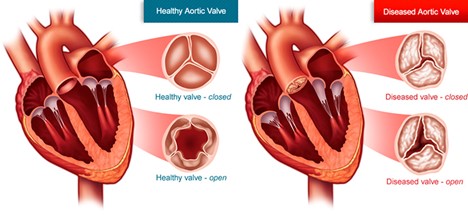
Transcatheter Aortic Valve Replacement (TAVR / TAVI)
Transcatheter aortic valve implantation (TAVI) or replacement (TAVR) is a minimally invasive procedure that involves inserting a catheter into a blood vessel in your upper leg and passing it towards your native aortic valve to implant a new valve.
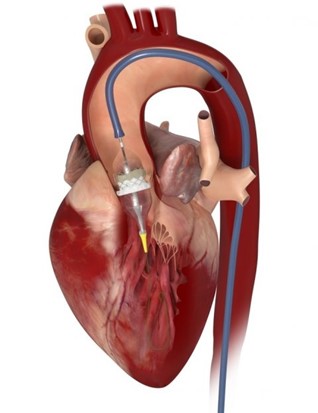
Under local anaesthetic, a small tube called a sheath will be inserted in the artery at the top of one of your legs or arm for taking pictures during the procedure. A slightly bigger sheath will be inserted into the artery at the top of your other leg, which the new valve will go through. Sometimes, a temporary pacemaker will be put into your heart through a vein in your neck or leg in case the doctor needs to speed up your heart during the procedure. Catheters (small tubes) are passed through the bigger sheath to pass a long ‘guide wire’ across the narrowed aortic valve. The new aortic valve is then advanced over this wire (like a train on rail tracks) until it is in place inside your narrowed valve and then expanded to push the narrowed valve open, creating a new valve within it. A small balloon (‘balloon catheter’) may be used to widen your narrowed aortic valve before the new aortic valve is placed. It may also be used to widen the new aortic valve after it has been implanted.
- It is a low risk minimally invasive procedure with quick recovery and short hospital stay.
- The main advantages of this technique are that the heart doesn’t need to be stopped, so a heart-lung (bypass) machine doesn’t need to be used, and it avoids making a large cut (incision) in your chest. This puts less strain on the body and may mean TAVI is more suitable for people who are at high risk to have a conventional valve replacement or need a quick recovery with shorter hospital stay.
Dr. Sumanto Mukhopadhyay trained in TAVI procedures in UK’s premier and high-volume centres, St. Bartholomew’s Hospital and Royal Brompton hospital in London. Following his Structural Heart Fellowship, he joined as a Consultant in Bart’s Heart Center , where he has gained unmatched expertise in advanced and high risk TAVI procedures involving anatomical challenges like bicuspid aortic valves, large annuli, pure aortic regurgitation, and valve-in-valve procedures including scenarios requiring specialized techniques like Basilica and LLAMACORN.
Overall he has done more than 2000 TAVI/TAVR procedures, the highest in the country. He has also trained several fellows in TAVI and structural interventions and has helped them secure consultant positions in prestigious institutes in UK, Australia, Israel and India. He has also proctored for new TAVI valves in more than 60 different hospitals across the world.
Dr. Sumanto’s commitment and expertise in the field of Structural Heart Interventions especially TAVI allows him to offer patient – centric solutions to each case thus ensuring every deserving patient is treated with best possible outcomes.